DBT for LGBTQ+

For LGBTQ+ individuals, daily life often comes with an extra layer of weight: the fear of rejection, the fatigue of explaining yourself over and over, the grief of an unsupportive family, the quiet exhaustion of hiding parts of who you are, punitive legislation, and, in some cases, the real danger of physical violence.
DBT wasn't built with LGBTQ+ people specifically in mind. Dr. Marsha Linehan developed it to treat chronic emotional dysregulation and self-harm. But its core philosophy, accepting reality as it is while pairing that acceptance with the skills to change what can actually be changed, turns out to map closely onto something a lot of LGBTQ+ people are already trying to do every day: live in a world that doesn't always make space for them, while still building a life worth living in it. In this guide, we'll walk through how each of DBT's four skill modules applies to LGBTQ+ mental health, and what the research actually says about how well DBT works for this community.
Jump to the topics:
Overview of DBT for LGBTQ+ Individuals
Dialectical Behavior Therapy is a structured, skills-based treatment that combines acceptance strategies with active behavior change, what Linehan called a synthesis of opposites. It grew out of standard CBT but folded in mindfulness and acceptance practices with roots in Buddhist philosophy. DBT is organized around four modules: mindfulness, distress tolerance, emotion regulation, and interpersonal effectiveness. Together, they work like a curriculum for managing intense emotions and relationships. The therapy was originally developed for chronic suicidality, self-harm, and borderline personality disorder, but its skills have since proven useful for depression, anxiety, substance use, PTSD, and more.
Why does this matter specifically for LGBTQ+ individuals? Because the skills DBT teaches, noticing an emotion without being swept away by it, tolerating distress without resorting to self-destructive coping, and communicating needs and limits clearly, are exactly the tools that help someone navigate stigma, family conflict, identity exploration, or the everyday work of being out in a world that doesn't always accommodate you. Mental health researchers increasingly point out that approaching treatment through the lens of minority stress and intersectionality matters here. A Black trans woman, a closeted gay man in an immigrant religious family, and a nonbinary teen in a rural school district are all carrying minority stress, but the specific shape of that stress, and which DBT skills will matter most, looks different for each of them. None of DBT's skills need to be reinvented for LGBTQ+ clients. They just need to be applied with real intention to someone's actual, specific stressors, rather than assumed to translate automatically because the label "LGBTQ+" is broad.
This isn't theoretical. Plenty of DBT programs already serve large LGBTQ+ populations. One UK adolescent DBT service found that 60 to 70 percent of its clients identified as LGBTQ+, with treatment engagement and outcomes comparable to their peers.
LGBTQ+ Mental Health and Minority Stress
LGBTQ+ individuals face measurably higher rates of depression, anxiety, substance use, self-harm, and suicidality than their cisgender, heterosexual peers. The minority stress model is the clearest explanation for why. It says LGBTQ+ people carry both external stressors, including discrimination, stigma, and social rejection, and internal ones, like fear of rejection or internalized shame, that accumulate over time and wear down resilience. For LGBTQ+ teens especially, a stigmatized identity layered on top of ordinary adolescent stress leaves them particularly vulnerable to self-harm and suicidal thoughts. Researchers studying this group describe it directly: a socially marginalized identity combined with normal teenage stress compounds risk in ways that are easy for clinicians to miss if they aren't looking for it.
This is exactly where DBT's combination of validation and skill-building should, in theory, fit well. And the outcome research backs that up. In a comprehensive DBT-A program, LGBQ adolescents showed significant improvements in emotion regulation, depression, borderline symptoms, and coping, with changes comparable to their heterosexual peers. A separate UK CAMHS DBT service found no significant differences in outcomes between sexuality-minoritized and heterosexual adolescents on measures of depression, anxiety, emotion dysregulation, and coping. DBT, in other words, works about as well for LGBTQ+ clients as it does for anyone else, and clients notice. In interviews, LGBTQ+ teens described their DBT groups as explicitly non-judgmental and said the skills themselves felt identity-neutral in a good way: they didn't discriminate based on who you were.
But the same interviews surfaced something else: those same teens wanted their therapists to proactively bring gender and sexual identity into the conversation, rather than waiting to be asked. That's the tension running through this whole piece. The skills are universal, and the stressors they're being used for are specific, and treatment works best when therapists acknowledge that tension.
That specificity is also where intersectionality does real work, rather than just sitting in the piece as a buzzword. Minority stress doesn't show up as one uniform experience. A queer person of color is often managing racism and homophobia or transphobia at the same time, sometimes from the same people or institutions. A queer person in a religious family may be navigating a conflict where coming out feels like it requires choosing between their faith community and themselves. DBT doesn't resolve that conflict, but it gives someone something to stand on while they're in the middle of it. A trans person in a rural area may be dealing with isolation and lack of access on top of everything else. None of this changes which four modules apply. It changes which skills within those modules deserve the most attention, and it's part of why "proactively bringing identity into the room" has to mean asking about which identities and which stressors, not just checking an LGBTQ+ box once and moving on.


Mindfulness: Grounded Awareness, Not Avoidance
Mindfulness in DBT means paying attention to the present moment, on purpose, without judgment. It's the foundation the other three modules sit on top of. For LGBTQ+ individuals, it offers something specific: a way to notice a hard thought or feeling about identity, even one that's accurate and genuinely painful, without either stuffing it down or getting completely pulled under by it.
Take a transgender teenager lying awake with the thought, "My family is going to reject me." Mindfulness isn't about arguing yourself out of that thought, and it's not about deciding whether it's true or false either. That's not what this skill is for. It's about noticing the thought show up, noticing the fear that comes with it, without immediately getting fused to it or acting on it. Then naming it, just the thought, in plain words, without piling on extra judgment like "I'm being dramatic" or "this is stupid." That's different from reassurance, and it's different from spiraling. It's just being in contact with what's actually there.
That same notice-and-name move helps after a hard coming-out conversation or an invalidating comment from a relative, not by forcing the rumination to stop, but by gently bringing attention back, again and again, to the present: your breath, your body, what's actually in front of you right now, instead of replaying the conversation for the tenth time.
You'll often hear DBT's "Wise Mind" described as something like inner peace, a calm place you retreat to. That's not quite right, and it's worth getting right because the rest of this piece leans on it. Wise Mind is what you get when emotion mind (urgent, feeling-driven, reactive) and reasonable mind (logical, fact-based, sometimes a little cold) come together. It's not a third, separate calm state, but a more complete way of knowing that includes both at once.
For someone dealing with identity-related stigma, that distinction actually matters. Emotion mind alone, after a hostile comment, might push you toward an impulsive blowup or going completely silent. Reasonable mind alone might produce a flat, detached non-reaction that ignores how much the comment actually hurt. Wise Mind holds both: acknowledging the hurt and the unfairness of it, while still choosing, on purpose, how to respond, instead of being run by either the hurt or a forced calm. That's not inner peace. It's getting enough accurate information from both sides of yourself to act from a clear place.
Distress Tolerance: Survival Skills for Stigma
Distress tolerance is DBT's crisis-survival module, a set of skills for getting through an intensely painful moment without making it worse. It doesn't ask whether the pain makes sense first; that's a job for emotion regulation. Distress tolerance just asks: can I get through this moment without creating a second problem on top of the first one? For LGBTQ+ individuals, the moments this module is built for aren't hypothetical. They include a slur at school, a coming-out conversation that goes sideways, a sudden wave of dysphoria, or a family member's voice on the phone.
The go-to skills here are mechanical and meant to be used fast: TIP (cold Temperature, Intense exercise, Paced breathing, Paired muscle relaxation) to bring an activated nervous system back down; grounding through your senses; self-soothing; distraction. If a gay teenager gets called a slur by a classmate, distress tolerance might look like stepping away to name five things they can see and hear, texting a friend who'll get it without needing the backstory, or taking slow breaths before responding at all. None of this fixes how unfair the moment was. It buys enough stability to choose what happens next on purpose, instead of from a flooded, reactive place.
Radical acceptance is the DBT skill most people have actually heard of, and the one most people slightly misunderstand. It means accepting reality as it is, not as it should be, without that meaning approval or agreement. Accepting that a parent isn't going to come around right now is not the same as accepting that their reaction is okay. Those are two different things, and DBT keeps them carefully separate. Radical acceptance is what lets someone stop spending all their energy fighting a fact that can't currently be changed, so that energy is free for the things that can.
This connects to something DBT calls willingness versus willfulness, and it matters a lot here. Willingness means working with reality as it is, not happily, not passively, just without piling extra resistance on top of pain that's already there. Willfulness is refusing to do that: insisting things should be different, refusing to take any step that even implicitly admits they aren't. Here's the important part for this community specifically: willfulness toward real injustice usually comes from a completely reasonable place. A queer person's anger at ongoing discrimination, at a family's slow or absent acceptance, or at legislation actively targeting their existence, isn't a character flaw or a skill they haven't learned yet. It's often a totally fair response to something genuinely unfair. DBT never asks anyone to be willing toward the injustice itself, only to be willing to act effectively in their own life while that anger is present and justified.


Emotion Regulation: Working With Shame, Grief, and Dysphoria
Emotion regulation is about identifying, understanding, and shifting the intensity of a difficult emotion, but DBT is clear that this only kicks in once you've checked whether the emotion actually fits the situation. A justified emotion, one that makes real sense given what's happening, calls for tolerating it and acting effectively anyway. An unjustified emotion, one that doesn't fit the facts or has overstayed its usefulness, is where you'd actually work to shift it. Skipping that first check and regulating every hard feeling the same way is one of the easiest ways this gets misapplied with marginalized clients. It risks treating an accurate read of a hostile world as if it were just a thinking error.
When the emotion is unjustified: A bisexual adult wrestling with internalized shame might start by simply naming it, "I feel ashamed," instead of letting it sit there, vague and overwhelming. From there, checking the facts: is "everyone will reject me" actually true, or is it a worst-case prediction built from a handful of painful memories? Here, the shame doesn't fit the facts, since being bisexual isn't actually shameful, so it's fair game to work on shifting it. The skill that follows is opposite action: shame's urge is to hide and withdraw, so the move is doing the opposite on purpose, telling a friend something you'd normally keep quiet, or showing up to a community event even when shame is pulling you toward the couch instead.
When the emotion is justified: Now picture a transgender teenager whose family has gotten more hostile since they came out, who feels real, intense fear about the next holiday gathering. Checking the facts here doesn't produce reassurance; it confirms the fear is accurate. The hostility is real. This is a justified emotion, and DBT doesn't ask anyone to talk themselves out of a correct read on danger. The work shifts from changing the feeling to tolerating it while still acting effectively, using distress tolerance skills to get through the gathering itself, using interpersonal effectiveness skills to hold a limit without over-apologizing for existing, and leaning on willingness rather than willfulness. Willingness doesn't mean deciding the family's behavior is okay. It means accepting that, right now, you can't force them to change, and that fighting that fact just adds a second layer of pain on top of the first. The fear doesn't have to go away for someone to act in line with what matters: safety, self-respect, and maybe distance, if that's what's needed.
This same logic applies to grief and dysphoria. Grief over a parent who hasn't come around, or dysphoria in a body that doesn't match who you are, are often completely justified responses to real loss or real incongruence, not distortions that need correcting. The goal isn't to make these feelings disappear. It's building the capacity to feel them fully while still functioning, still connecting, and still moving toward a life that feels like your own. The research backs up that this kind of growth is achievable. The same DBT-A studies found LGBQ adolescents made real gains in emotion regulation and coping, right on par with their straight peers. That's not the disappearance of hard feelings. It's a stronger, steadier relationship with feelings that often make complete sense given what someone's actually up against.
Interpersonal Effectiveness: Speaking Up Strategically
Knowing What You're Actually Going For
Interpersonal effectiveness is DBT's module for getting needs met, holding limits, and navigating conflict, but the step people skip is figuring out, before picking a skill, what you're actually trying to accomplish in this specific conversation. DBT names three different goals, and they can pull against each other:
- Getting the outcome you want uses the DEAR MAN skill (Describe, Express, Assert, Reinforce, stay Mindful, Appear confident, Negotiate).
- Protecting the relationship uses the GIVE skill (Gentle, Interested, Validate, Easy manner).
- Keeping your self-respect intact uses the FAST skill (Fair, no Apologies, Stick to values, Truthful).
These goals genuinely compete sometimes, and picking the right one on purpose matters. This is especially true for the scenarios this piece keeps coming back to. A coming-out conversation, a request to use a chosen name, a limit around an invasive question: in most of these, the outcome you actually want, full agreement, the slur stopping for good, your relative nailing the new name on the first try, often isn't fully in your control. What is in your control is whether you act in line with your own values and walk away with your dignity intact. That's a self-respect goal, which means FAST is frequently the more useful skill here, even though DEAR MAN tends to get all the attention because it's the most concrete and easiest to teach.
That doesn't make DEAR MAN wrong. It's the right call when the outcome genuinely matters and is genuinely gettable, such as asking a manager to use the correct pronoun in official emails, where there's a real, specific ask and a real shot at a yes. The skill should match the goal. If what you want is "my mother accepts my marriage today," DEAR MAN structures that conversation. If what's actually achievable, and what you need regardless of how she responds, is "I said this clearly, I didn't shrink or over-apologize, and I can live with how I showed up," that's FAST. Naming that distinction with someone before a hard conversation, instead of handing them DEAR MAN by default, is often the more useful move.
GIVE matters most when the relationship itself is worth protecting even at some cost to the other two goals. This shows up a lot in family-of-origin situations, where someone is choosing, on purpose, to preserve a relationship through a slow, ambivalent acceptance process rather than push for resolution right now. That's a legitimate choice. It isn't giving in if it's made with open eyes about what's actually being prioritized and why.
Community-building belongs here too, even though it's a different kind of skill than the acronyms above. Adolescents in DBT programs consistently name connection with accepting peers as a protective factor, and building that network, through a GSA, an online community, or a smaller circle of accepting friends, is itself an interpersonal effectiveness goal, not just a nice side effect of treatment. The point of this module isn't only surviving hard one-off conversations. It's cutting down how often those conversations have to be load-bearing in the first place, by making sure they're not someone's only source of connection.
Is There Evidence That DBT Works for LGBTQ+ Individuals?
The research base here is still young, but it's growing, and what exists is encouraging.
Comparable outcomes to peers. In a comprehensive DBT-A program, LGBQ adolescents (n=16) showed improvements in emotion regulation, depression, borderline symptoms, and coping that were statistically comparable to their non-LGBQ peers (n=23). DBT wasn't less effective for this group; it worked about as well as it did for everyone else in the program.
Real-world replication in a clinical setting. A separate study out of a UK National & Specialist CAMHS DBT service compared sexual and gender minority adolescents to their cisgender, heterosexual peers and found no significant differences in depression, anxiety, borderline symptoms, emotion dysregulation, or coping by the end of treatment. This matters because it wasn't a small research trial. It's outcomes from an actual clinical service, which is closer to what most people will experience if they pursue DBT themselves.
Clients value the nonjudgmental structure, but want more. A qualitative study interviewing gender and sexuality minoritized adolescents in DBT found that participants experienced the program as explicitly non-judgmental and safe, and felt the skills themselves applied regardless of gender or sexual identity. At the same time, those same interviews surfaced a clear ask: clients wanted therapists to proactively raise gender and sexual identity rather than waiting to be asked, and they pointed to connection with accepting community as a meaningful protective factor.
Adapted curricula are emerging. Beyond outcome studies, researchers have started publishing structured, LGBTQIA+-affirming adaptations of existing DBT curricula. One recent example walks practitioners through DBT STEPS-A module by module, with specific guidance for adapting language, examples, and coping strategies to reflect minority stress, instead of leaving clinicians to improvise that translation on their own.
Taken together, this evidence suggests DBT isn't a treatment that just happens to also work for LGBTQ+ people. It's a treatment whose core mechanism, validation paired with skill-building, lines up unusually well with what minority stress research says this community actually needs, and the outcome data so far backs that up.
Psychoeducation as an Affirming Starting Point
Not everyone who wants DBT skills needs, or has access to, full clinical therapy right away. For a lot of LGBTQ+ people, that's not just a preference; it's a real access problem. Affirming providers can be hard to find, insurance coverage can be inconsistent, and full DBT, which often means weekly individual sessions plus weekly group plus phone coaching, is a significant commitment even when none of those barriers exist. This is exactly where psychoeducational resources can play a meaningful role.
TheraHive offers DBT skills training through courses, blog content, and video, as an educational complement to therapy, not a replacement for it. For LGBTQ+ individuals specifically, learning the four modules in a structured, low-stakes setting can be a powerful first step. It builds a vocabulary for emotions, a toolkit for crisis moments, and a framework for navigating identity-related stress, all before, or alongside, any decision about pursuing individual therapy.
DBT's life skills aren't limited to any one diagnosis or population, and that case extends naturally to LGBTQ+ individuals navigating identity-specific stress. Pairing that kind of general psychoeducation with explicit, identity-aware framing, such as learning to notice anxious thoughts about disclosure without judgment, or practicing radical acceptance toward a relative's slow process of understanding, helps bridge the gap between generic DBT skills and the specific shape of minority stress.
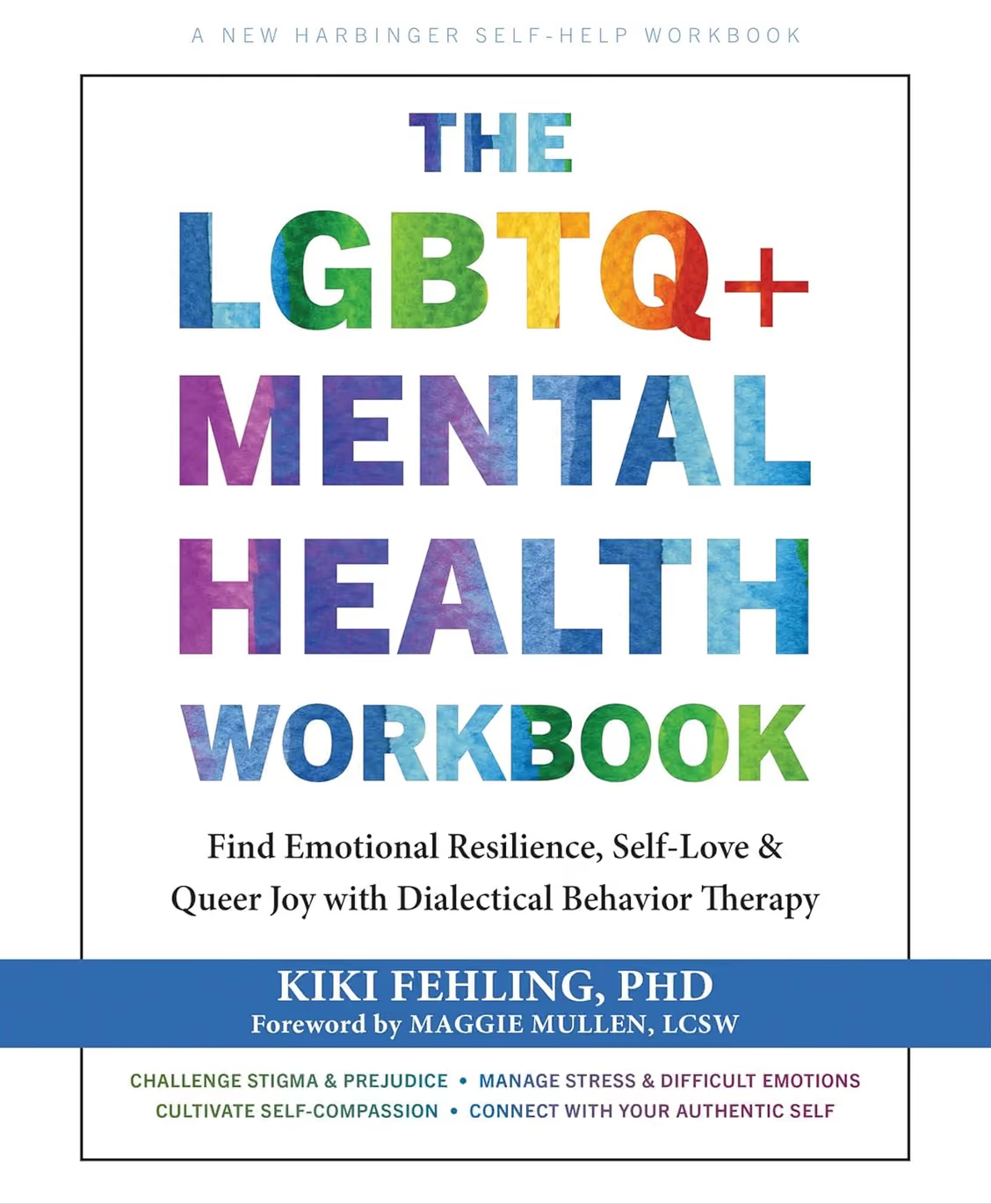
For readers who want this kind of identity-aware framing built into the material from the start, rather than adapted onto it after the fact, The LGBTQ+ Mental Health Workbook by Dr. Kiki Fehling, a queer DBT psychologist, takes exactly that approach. Instead of teaching generic DBT skills and leaving readers to translate them, the workbook moves through chapters built around the realities of queer and trans life directly, covering coping with LGBTQ+-specific stress, connecting with an authentic self, nurturing gender euphoria, and building strong community, while still grounding every chapter in standard DBT skills like emotion regulation, distress tolerance, and self-compassion. It's a useful next step for anyone who's read through the modules above and wants a structured, queer-affirming workbook to put them into practice.
Conclusion
DBT wasn't written with LGBTQ+ experience in mind, and yet its central dialectic, accepting reality fully while working to change what can be changed, turns out to describe something many LGBTQ+ individuals are already trying to do every day. Mindfulness offers a way to stay in contact with identity-related fear or shame without being swept away by it. Distress tolerance provides concrete tools for surviving acute moments of stigma or rejection. Emotion regulation builds a steadier relationship with shame, grief, and dysphoria, including the feelings that are entirely justified given what someone's up against. Interpersonal effectiveness gives people language and structure for the hardest conversations, coming out, asserting pronouns, holding a limit, while also helping them build the accepting community that protects against minority stress in the first place.
The research so far is consistent: DBT works about as well for LGBTQ+ clients as it does for anyone else, and clients themselves report finding real safety in its nonjudgmental structure. The clearest opportunity for improvement isn't the skills themselves. It's making sure therapists actively bring identity into the room, in its specifics, rather than waiting for clients to raise it alone. For LGBTQ+ individuals exploring whether DBT might help, that combination, proven skills applied with real intention, is worth taking seriously.
Reading about these four modules is one thing; building the muscle memory to use them in an actual hard moment is another. That's the gap a structured skills group is built to close. TheraHive's DBT Skills Groups walk through mindfulness, distress tolerance, emotion regulation, and interpersonal effectiveness in a guided, ongoing setting, the kind of repeated practice that turns a concept like radical acceptance or opposite action into something you can actually reach for the next time a hard conversation or a hard feeling shows up. If anything in this guide felt familiar, exploring TheraHive's DBT Skills Groups is a low-stakes way to start building that toolkit.
References
Poon, J. A. et al. (2022). Dialectical Behavior Therapy for Adolescents (DBT-A): Outcomes Among Sexual Minorities at High Risk for Suicide. Suicide and Life-Threatening Behavior
Camp, J. et al. (2024). Clinical Outcomes for Sexual and Gender Minority Adolescents in a Dialectical Behaviour Therapy Programme. Behavioural and Cognitive Psychotherapy
Camp, J. et al. (2024). Gender- and Sexuality-Minoritised Adolescents in DBT: A Reflexive Thematic Analysis of Minority-Specific Treatment Targets and Experience. the Cognitive Behaviour Therapist
Weinberg, J. R. et al. (2024). Providing LGBTQIA+ Affirming Mental Health Services in Schools: A Cultural Adaptation of Dialectical Behavior Therapy Skills Training for Emotional Problem Solving for Adolescents (DBT STEPS-A). School Mental Health
Related Reading





.avif)