What Is Dialectical Behavior Therapy (DBT)?

DBT is a skills-based approach designed to help people navigate intense emotions, improve relationships, and build a life that feels more manageable. Whether you're encountering DBT for the first time or deepening a practice you've already started, this page offers a comprehensive look at where DBT comes from, how its core modules work, and what the research says about why it's effective.

Jump to the topics:
Overview of DBT
Dialectical Behavior Therapy, commonly known as DBT, is a structured, skills‑based psychological treatment originally developed to help people manage intense emotions and patterns of behavior that feel overwhelming or difficult to control. Over time, DBT has evolved into a widely used, evidence‑supported approach for improving emotional regulation, distress tolerance, interpersonal functioning, and mindful awareness across a range of mental health challenges.
DBT is best understood not only as a therapy model, but also as a system for teaching practical life skills. Many people encounter DBT through skills classes, psychoeducational programs, or self‑guided learning environments rather than traditional psychotherapy. TheraHive is one such psychoeducational platform and does not provide therapy or clinical treatment.
This page provides an encyclopedic overview of DBT, its historical roots, its core skills modules, and the scientific evidence supporting its use. It is written for adults seeking to better understand DBT for themselves or for someone they care about.

Historical Background and Theoretical Lineage
Dialectical Behavior Therapy was developed in the late 1980s by psychologist Marsha M. Linehan while working with individuals experiencing chronic emotional dysregulation and suicidal behaviors. At the time, existing cognitive‑behavioral approaches were often insufficient for people whose emotions escalated rapidly and intensely.
DBT grew out of Cognitive Behavioral Therapy and retains many CBT foundations, including behavior change strategies, skills training, and structured problem solving. However, Linehan observed that an exclusive focus on change could feel invalidating to individuals who were already struggling with shame and emotional pain. To address this, DBT introduced a central dialectic: balancing acceptance and change at the same time.
The acceptance component of DBT is strongly influenced by Eastern contemplative traditions, particularly mindfulness practices rooted in Zen Buddhism. These practices emphasize present‑moment awareness, nonjudgmental observation, and acceptance of internal experience. DBT integrates these principles with Western behavioral science, creating a model that teaches people how to acknowledge reality as it is while also learning how to change behaviors that cause suffering.
The term dialectical reflects this synthesis. In DBT, healing comes from learning how to hold two seemingly opposite truths at once: accepting oneself fully while working toward meaningful change.


Dialectical Philosophy of DBT
Dialectics is literally part of DBT's name, and it reflects the therapy's organizing philosophical principle: that two seemingly opposite truths can both be valid at the same time, and that holding them together produces something more complete than either alone. Linehan defines DBT as "a synthesis or integration of opposites," and the therapeutic process mirrors the classical philosophical movement from thesis to antithesis to synthesis. In clinical practice, this means that therapists actively hold two truths at once: fully validating a client's experience as it is right now, while simultaneously pushing for meaningful change. Neither alone is sufficient. Pure acceptance without change leaves a person stuck. Pure change without acceptance feels invalidating and often drives people out of treatment entirely.
This central dialectic emerged from Linehan's parallel commitments to behaviorism and Zen Buddhism. She recognized that the Zen principles of mindfulness and radical acceptance could provide the necessary counterbalance to the change-oriented strategies of behavioral therapy, and that weaving them together was what her clients actually needed. After the philosophical concept of dialectics was adopted as the unifying framework, the entire treatment was scrutinized to ensure consistency with the underlying philosophy, culminating in the publication of the treatment manual in 1993.
In practice, this dialectical stance shows up throughout every layer of DBT. Skills groups teach both acceptance strategies and change strategies across all four modules, and the full model of DBT is structured to balance these simultaneously in individual therapy, phone coaching, and the therapist consultation team. Clients are also explicitly taught to apply dialectical thinking to their own lives, learning to recognize when they are stuck in all-or-nothing thinking and to search for the synthesis. Common dialectical tensions that come up in treatment include "I am doing the best I can" and "I need to do better," or "I want to change" and "change feels threatening." Holding both sides of these without collapsing into one is itself a skill.
One process study testing DBT theory found that dialectical techniques balancing acceptance and change were more effective than pure change or acceptance techniques alone in reducing suicidal behavior, providing direct empirical support for the philosophy as a clinical tool, not just a theoretical frame.
To dive deeper into dialectics, check out our blog post Understanding Dialectics: The Heart of DBT.
Who Can Benefit from DBT
DBT was originally developed for a very specific and underserved population: people with borderline personality disorder (BPD) who were chronically suicidal and had largely not responded to other treatments. Linehan and her colleagues found that DBT resulted in significant improvements for chronically suicidal and self-injuring women with BPD, a clinical population that had previously been viewed as untreatable. That foundational success established DBT as the gold-standard treatment for BPD, a designation it continues to hold.
In the decades since, the range of people who benefit from DBT has expanded considerably. Because the core problems DBT targets, specifically emotion dysregulation, impulsive behavior, and difficulty tolerating distress, show up across many different diagnoses and life situations, researchers and clinicians have adapted the treatment well beyond its original scope. The empirical literature supports the use of DBT for BPD comorbid with substance use disorders and PTSD, and independent of a BPD diagnosis, research supports its use for treatment-resistant depression, eating disorders, and depression in older adults with mixed personality features. A 2024 literature review confirmed that DBT now has Level 1 evidence for binge eating disorder and Level 2 evidence for depression, bipolar disorder, bulimia, and PTSD.
DBT has also been adapted for adolescents, for parents, for people in substance use recovery, and for workplace and healthcare settings. The thread connecting all of these applications is the same: when someone's emotions feel too large to manage, or when patterns of avoidance, self-harm, conflict, or shutdown keep repeating despite genuine effort to change, DBT skills offer a concrete and learnable path forward.
Importantly, a formal diagnosis is not required to benefit from DBT psychoeducation. Many people who have never been diagnosed with anything find that DBT skills speak directly to experiences they have struggled to name: the intensity of certain emotions, the difficulty communicating needs without conflict, the pull toward behaviors that provide short-term relief but long-term harm. The skills are practical enough to be useful to anyone willing to practice them.


Core Structure of DBT
DBT is organized around four primary skills modules. Each module targets a different aspect of emotional and behavioral functioning, while reinforcing the others. Together, they form a comprehensive framework for building a life that feels more stable, intentional, and aligned with personal values.
Before exploring each module in depth, many learners benefit from a high‑level overview of how the skills fit together. Our DBT Module Explainer Video that introduces all four skills modules and illustrates how they can be combined in real‑world situations to support long‑term goals and daily coping.
Mindfulness Module
Mindfulness is the practice of paying attention to the present moment with openness and without judgment. In DBT, it is treated not as a relaxation exercise but as a foundational skill for noticing thoughts, emotions, bodily sensations, and urges without immediately reacting to them. It is the first of the four DBT skill modules and the one that underlies all the others.
DBT teaches mindfulness through two categories of skills: "what" skills and "how" skills. The "what" skills are observing, describing, and participating. The "how" skills are being nonjudgmental, staying one-mindful, and acting effectively. Together, these practices train a person to engage with their inner experience deliberately rather than automatically.
In daily life, mindfulness skills directly support emotional stability, focus at work and in relationships, and the ability to pause before reacting during conflict. For people who struggle with rumination, anxiety, or emotional flooding, mindfulness creates the internal space needed to choose a response rather than be driven by one. It is also foundational to Wise Mind, the DBT concept describing the integration of rational thinking and emotional awareness.
Research indicates that mindfulness-based interventions can reduce emotional reactivity and improve emotion regulation by altering how individuals respond to stress and internal cues. Try out our short Mountain Meditation below, and explore our entire playlist of mindfulness exercises on YouTube for more.
Distress Tolerance Module
Distress tolerance is the DBT skill module focused on surviving moments of intense emotional pain without taking actions that increase harm or suffering. It is designed for crisis situations, panic states, and circumstances that cannot be immediately changed or resolved.
The skills in this module fall into two broad categories: crisis survival skills and acceptance skills. Crisis survival skills include sensory grounding, paced breathing, temperature-based interventions (such as cold water on the face or wrists), and short bursts of physical activity. Acceptance skills include radical acceptance, turning the mind, and willingness, which help individuals stop fighting reality and reduce the secondary suffering that comes from resistance.
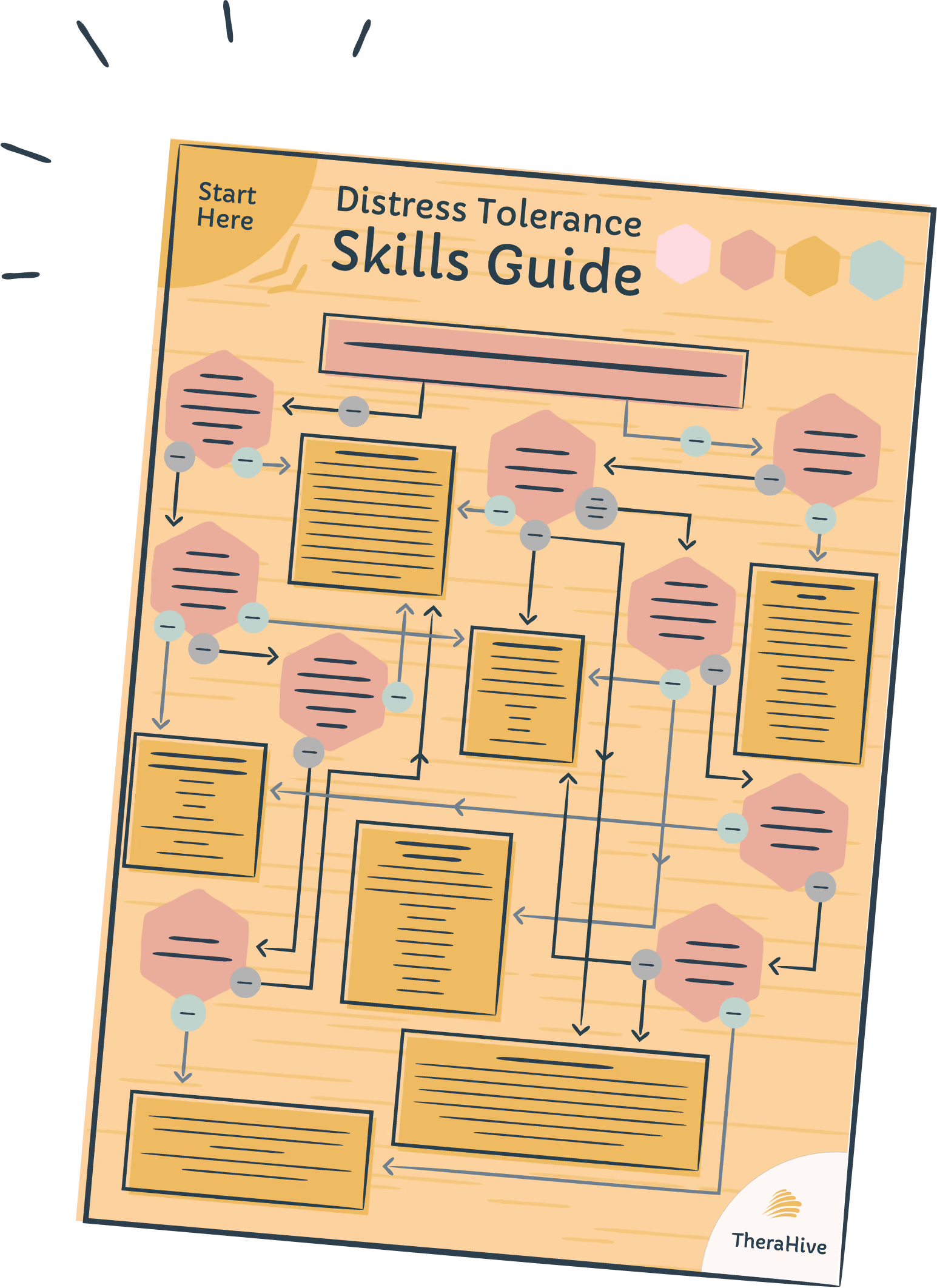
Distress tolerance does not aim to eliminate pain. It aims to keep a difficult moment from becoming a worse one. If you could use some help finding the right Distress Tolerance skill to use for your particular situation, check out our free interactive tool here or download our printable poster below!
These skills are particularly relevant in moments involving overwhelming emotion, urges to engage in harmful behaviors, or situations where problem-solving is not yet possible. By calming the body's physiological arousal first, distress tolerance creates enough stability for other DBT skills to be used effectively once the crisis has passed. Cold-temperature interventions activate the mammalian dive reflex, slowing heart rate and reducing physiological anxiety.
Emotion Regulation Module
Emotion regulation is the DBT skill module focused on understanding, managing, and changing intense emotional responses. In DBT, emotions are viewed as functional and informative, but problems arise when they become extreme, frequent, or difficult to influence.
The skills in this module include identifying and labeling emotions accurately, understanding how emotions are triggered and maintained, reducing physical and situational vulnerability through the ABC PLEASE skills, building positive experiences to increase emotional resilience, and acting opposite to unhelpful emotional urges. Together, these skills address both the short-term experience of difficult emotions and the longer-term patterns that make emotional distress more likely.
Emotion regulation skills are useful across almost every area of life, from managing stress at work and in relationships to reducing the intensity of anxiety, shame, and anger. For people who feel controlled by their emotions, these skills offer a path toward greater agency, not by suppressing feelings, but by understanding them well enough to influence how long they last and what they drive.
A 2025 peer-reviewed study found that stronger emotion regulation skills were associated with lower anxiety severity and greater psychological resilience, suggesting that improving regulation capacity plays a key role in emotional well-being.
Interpersonal Effectiveness Module
Interpersonal effectiveness is the DBT skill module focused on communicating clearly, maintaining relationships, setting boundaries, and preserving self-respect during difficult interactions. Because emotional distress is so often rooted in or amplified by interpersonal conflict, this module is designed to give people concrete tools for navigating the social situations that tend to be the most destabilizing.
The module is organized around three goals and three corresponding skill sets. The first is objective effectiveness, or getting what you need from an interaction, taught through the DEAR MAN skill (Describe, Express, Assert, Reinforce, stay Mindful, Appear confident, Negotiate). The second is relationship effectiveness, or maintaining and strengthening the connection itself, taught through the GIVE skill (be Gentle, act Interested, Validate, use an Easy manner). The third is self-respect effectiveness, or staying true to your values regardless of the outcome, taught through the FAST skill (be Fair, no Apologies for existing, Stick to values, be Truthful). Together these skills address the full complexity of a difficult interaction rather than focusing on just one dimension of it.
In everyday life, these skills help with asking for what you need without guilt, saying no without damaging relationships, setting limits with family members or coworkers, and repairing trust after conflict. For people who struggle with anxiety around social evaluation, chronic conflict avoidance, or difficulty asserting needs, they provide a structured and repeatable approach to interactions that would otherwise feel overwhelming. A 2024 study published in Perspectives in Psychiatric Care found that interpersonal effectiveness skill training improved both social functioning and communication competence in individuals with depressive disorder, supporting the value of this module beyond its original BPD context.
DBT as a Mental Fitness Framework
DBT is increasingly described as a form of mental fitness training rather than solely a clinical intervention. Like physical fitness, emotional skills improve through repetition, practice, and progressive challenge.
TheraHive’s video on DBT as a Mental Health Gymexplains how DBT skills function like mental muscles that strengthen resilience, emotional control, focus, and confidence over time. This framing emphasizes growth, agency, and long‑term skill development rather than symptom elimination.
Psychoeducation and Accessibility
A defining feature of DBT is its psychoeducational structure. Skills are explicitly taught, practiced, reviewed, and refined over time. This educational approach empowers individuals to understand their internal experiences and actively participate in change.
TheraHive provides psychoeducational DBT resources and does not offer psychotherapy or medical treatment. Educational programs are designed to complement, not replace, professional care.
Those seeking a structured introduction may also explore TheraHive’s free Navigating DBT mini‑course led by Dr. Alicia Smart, which provides foundational instruction and practical guidance for applying DBT skills in daily life.
For individuals curious about whether DBT may be helpful for their needs, TheraHive offers a brief self‑assessment titled Is DBT For You?, which explores emotional patterns, stress responses, and goals.
Evidence Base for DBT
DBT was developed by Dr. Marsha Linehan at the University of Washington, and its evidence base begins with her own clinical trials. In the landmark 1991 randomized controlled trial published in the Archives of General Psychiatry, Linehan and colleagues evaluated DBT as a treatment for chronically parasuicidal women with borderline personality disorder, comparing it against treatment as usual in the community over one year. Participants who received DBT had fewer instances of parasuicide and less medically severe self-injurious behavior, were more likely to remain in individual therapy, and had fewer psychiatric inpatient days. This was a population previously considered largely untreatable, and the results were significant enough to establish DBT as a serious clinical intervention.
A follow-up naturalistic study published in 1993 tracked the same participants through a one-year post-treatment period and found that DBT's advantages over treatment as usual were largely retained, with DBT participants showing significantly higher global functioning scores, less parasuicidal behavior during the first six months of follow-up, and fewer psychiatric inpatient days during the final six months.
Linehan's second major trial went further. The 2006 randomized controlled trial, also published in the Archives of General Psychiatry, was designed to test whether DBT's effectiveness was due to the specific treatment itself or simply to the quality of expert clinical attention. The study compared DBT against therapy provided by non-behavioral psychotherapy experts over one year, with a one-year follow-up. The findings replicated earlier results and concluded that DBT's effectiveness could not reasonably be attributed to general factors associated with expert psychotherapy, with DBT appearing to be uniquely effective in reducing suicide attempts.
In the decades since Linehan's foundational work, DBT has been extensively researched for individuals with a wide range of mental health conditions in diverse clinical settings around the world. A PubMed-indexed randomized trial by Neacsiu and colleagues found that DBT skills training significantly reduced anxiety and depressive symptoms in adults with high emotional dysregulation, with skills use directly mediating improvement. DBT continues to be studied both as a standalone skills-based intervention and as a complementary framework alongside other therapeutic approaches.
Conclusion
Dialectical Behavior Therapy offers a structured, evidence‑informed system for understanding emotions, tolerating distress, improving relationships, and cultivating mindful awareness. By integrating acceptance‑based practices with behavioral change strategies, DBT provides practical tools for navigating life’s challenges more skillfully.
As a psychoeducational model, DBT emphasizes learning, practice, and personal agency. Whether used within therapy or through educational platforms like TheraHive, DBT skills support long‑term emotional resilience and a life guided by intention rather than emotional reactivity.
References
- Linehan et al. (1991) – Landmark randomized controlled trial of DBT for chronically parasuicidal women with BPD, Archives of General Psychiatry
- Linehan et al. (1993) – Naturalistic one-year follow-up of DBT vs. treatment as usual, Archives of General Psychiatry
- Linehan et al. (2006) – Two-year randomized controlled trial of DBT vs. therapy by experts for suicidal behaviors and BPD, Archives of General Psychiatry
- Neacsiu et al. (2014) – Randomized trial of DBT skills training for emotional dysregulation, anxiety, and depression, PubMed
- Linehan & Wilks (2015) – The course and evolution of Dialectical Behavior Therapy, ResearchGate
- Linehan (1994) – DBT theoretical and empirical foundations, PubMed
- Ritschel et al. (2015) – Transdiagnostic applications of DBT for adolescents and adults, American Journal of Psychotherapy
- Atta et al. (2024) – Interpersonal effectiveness skill training and social functioning in depressive disorder, Perspectives in Psychiatric Care
- Peprah & Argáez (2017) – Dialectical Behavioral Therapy for Adults with Mental Illness: A Review of Clinical Effectiveness and Guidelines
- Smith et al. (2012) – Use of the human dive reflex for the management of supraventricular tachycardia: a review of the literature
- Do et al. (2025) – Emotion regulation, anxiety severity, and psychological resilience
Related Reading





.avif)