DBT for Families

When one family member struggles, the whole household can feel it. Conflict can leave everyone walking on eggshells, unsure what to do next. Dialectical Behavior Therapy (DBT) helps families interrupt unhelpful patterns and respond more effectively. Learn how DBT applies to family life, how it complements family-focused treatments, and what the research says about DBT skills training for the whole family.

Jump to the topics:
Overview of DBT for Families
Dialectical Behavior Therapy (DBT) started as a treatment for one specific, narrow problem: adults with chronic suicidality who weren't responding to standard talk therapy. Psychologist Marsha Linehan developed it in the 1990s after noticing that many of these patients had grown up in what she called invalidating environments, homes where a person's emotional reactions were routinely dismissed, punished, or met with confusion rather than understanding.
Borderline Personality Disorder (BPD) became the diagnosis DBT was first tested against and built its early reputation on, but the treatment's real target was always broader than one condition: emotions that run hotter and longer than the people around a person know how to manage. That's why DBT has since grown well past its original scope, now used to treat substance use, eating disorders, depression, anxiety, and a range of other conditions where emotion dysregulation is the common thread rather than BPD specifically.
Families sit closer to the center of that expansion than almost anywhere else DBT has grown into. An invalidating environment, by definition, involves the people closest to someone, not just the person struggling, which is part of why DBT's most established extension for young people, DBT for Adolescents (DBT-A), was built from the start to include parents and carers directly in treatment rather than treating the adolescent as the only one who needs new skills.
- Mindfulness slows the reflex to join someone else's crisis before checking your own reaction to it. A parent or sibling can get swept into an escalating argument almost automatically, matching volume for volume, without ever noticing there was a choice point.
- Distress tolerance covers the minutes when insight isn't available to anyone in the room. A self-harm disclosure, a screaming match, or a late-night phone call doesn't leave space for reflection, and this module supplies something to do with the body while the crisis is still live.
- Emotion regulation works on the household's shared emotional climate, not just one person's mood. Families under sustained stress tend to develop a pattern of criticism and over-involvement that keeps everyone's nervous system on alert, and this module gives people a way to interrupt that buildup before it becomes the norm.
- Interpersonal effectiveness gives family members a way to hold a limit and stay in the relationship at the same time. Households in crisis often swing between over-accommodating and shutting down entirely, and this module is built for the middle ground.
That inclusion shows up differently across DBT's four modules once a family, rather than one individual, is the unit being supported.
Families rarely move through a difficult interaction one problem at a time, which is part of why these four modules aren't meant to be treated as separate toolkits. Skills from different modules can work together within the same conversation: using mindfulness to notice when you're getting pulled into an argument, distress tolerance to keep from reacting in the heat of the moment, emotion regulation to understand what is fueling your own response, and interpersonal effectiveness to communicate a boundary without turning it into another fight. The goal isn't for each family member to reach for one module at a time, but to combine skills as the situation calls for them. Learn more about skill stacking in the case study video below.
The rest of this page covers each of those four modules in more depth, what makes DBT different from other family-focused treatments, and what the research base, still smaller than the evidence for DBT delivered to individuals, actually supports when it comes to teaching these skills across a household rather than to one person alone.
DBT vs. Other Treatments
Families dealing with a member's severe emotion dysregulation, self-harm, or repeated crisis have more than one evidence-based path available, and DBT isn't positioned to replace any of them so much as to add a specific piece: repeatable, teachable skills for the moment a crisis is actually unfolding.
Systemic family therapy, which works directly on family relationships and communication patterns rather than teaching individual skills, is probably the closest comparison point, and the results here are more mixed than many people expect. A large UK multicentre trial testing manualized systemic family therapy against standard outpatient care for adolescents referred after self-harm found that family therapy conferred no added benefit over treatment as usual in reducing hospital attendance for repeated self-harm over eighteen months, a result that surprised the field and pushed researchers to look harder at which specific ingredients within family-focused treatment actually move outcomes. Attachment-based family therapy, another established family-focused model built around repairing ruptures between an adolescent and caregiver, has produced a similarly uneven picture. A systematic review and meta-analysis of randomized trials testing attachment-based family therapy for suicidal youth found the approach was not significantly more effective than active or waitlist controls on suicidal ideation or depressive symptoms, even though individual trials within that body of research have shown stronger results.
Multisystemic therapy takes a different angle entirely, treating the adolescent's behavior as a function of the whole social ecology, family, school, and peer group, rather than working through weekly office sessions. A randomized trial comparing intensive, home-based multisystemic therapy to psychiatric hospitalization for youth in suicidal crisis found significantly greater reductions in youth-reported suicide attempts among adolescents who received the home-based model, though effects on suicidal ideation and caregiver-reported attempts were less consistent. That result speaks to something DBT shares with multisystemic therapy: both treat the environment around a struggling young person as part of the problem worth working on directly, rather than something to be managed from the outside while treatment happens elsewhere.
What distinguishes DBT's approach to families is where it puts parents and carers to work. Rather than treating the family unit primarily as the subject of therapy, comprehensive DBT for adolescents embeds parents directly into skills acquisition, teaching them the same mindfulness, distress tolerance, emotion regulation, and interpersonal effectiveness tools their adolescent is learning, often in a dedicated group of their own. A pilot randomized trial comparing parallel adolescent and parent DBT skills training to adolescent-only skills training found that when parents attended their own concurrent skills group instead of sitting out entirely, adolescents showed larger reductions in anxiety and depressive symptoms and reported far more frequent positive interactions with their parents by the end of the twelve-week program. That structure, teaching the people around a struggling family member the same concrete tools rather than asking them to simply support someone else's treatment from the sidelines, is the piece DBT tends to add to what family systems and attachment-based approaches already offer.
None of this makes DBT the automatic first choice for every family. A household in the middle of a child's eating disorder will often be better served starting with family-based treatment, which is built specifically around a parent's short-term authority to guide a child's eating rather than teaching the child new coping skills first. A family dealing mainly with delinquent or antisocial behavior may get more from multisystemic therapy's intensive, home-based structure. What DBT tends to offer most families is a skill set that works alongside whichever other treatment is already in the picture, something a parent can use tonight rather than after months of relational work have had time to take hold.


Psychoeducation as a Starting Point for Families
When one family member is in crisis, everyone around them tends to develop a private theory about why. One person calls it manipulation, another calls it an illness, a third insists it will pass with enough discipline. Those competing explanations rarely get said out loud, and they quietly shape how each person reacts the next time a crisis actually happens. Psychoeducation does something a family argument about the "real" explanation usually can't: it gives everyone in the household the same working model of what emotion dysregulation actually is and how it tends to operate, before anyone is asked to change their own behavior.
This matters more for families than it does for an individual working through the same material alone, because the skill has to land with more than one person who will then go home and interact with each other using it. A parent who understands validation only in the abstract behaves differently in the moment than one who has practiced naming it out loud during their own skills group. NIMH describes caregiver and family-focused education as valuable for exactly this reason: loved ones often need direct help understanding a family member's condition, recognizing what makes caregiving harder than it has to be, and learning approaches that support change rather than accidentally reinforcing the pattern everyone is trying to interrupt, according to NIMH's overview of borderline personality disorder. That's a meaningfully different starting point than assuming every family member already knows what to do and simply isn't doing it.
Coordinating one person's schedule around a course of skills training is hard. Coordinating a parent's schedule, an adolescent's schedule, and sometimes a sibling's around the same one is harder still, which is part of why virtual learning has become a meaningful piece of how families actually access this kind of program. A session that doesn't require a parent to drive across town after work, or a teenager to leave school early, tends to get attended more consistently than one that does, and consistency is what the research on family-based skills training points to as the thing that predicts real change.
TheraHive's programs are psychoeducational, not psychotherapy or family therapy, and not a treatment for any single diagnosis. The goal is teaching and rehearsing DBT skills in a structured, virtual group format, alongside whatever individual therapy or family work a household may already be doing, not replacing it. For families where one member's crisis has already stretched everyone's time and attention thin, a lower-friction way for the rest of the household to build the same skill set tends to matter quite a bit.
Mindfulness Skills for Families
Families under chronic stress develop a specific reflex: matching the emotional temperature of whoever is escalating fastest. A teenager raises their voice, and a parent's voice rises to meet it before either person has decided to respond that way at all. Mindfulness is the DBT module built to interrupt that reflex, and it works through skills that get practiced directly rather than through a vague instruction to stay calm.
Observe comes first. It means noticing an internal reaction as it's happening, before deciding what to do about it, whether that's a tightening in the chest when a phone buzzes at an odd hour or the urge to lecture the second a door slams. Describe follows, turning that raw reaction into plain, factual language instead of a sweeping judgment. "I'm noticing an urge to yell back" reads differently than "I have to shut this down right now," even though the two tend to collapse into one without practice. That small gap, created through Observe and Describe, is often the first real leverage a parent or sibling gets over a reaction that used to feel automatic.
One-mindfully addresses a related pattern common in families managing an ongoing crisis: doing one thing while a separate track runs underneath it, half-listening to a spouse over dinner while mentally rehearsing tomorrow's difficult conversation with a child. Practicing this skill means deliberately returning attention to what's actually happening right now, each time it drifts toward the next anticipated crisis.
Nonjudgmentally tends to matter most for how family members treat themselves once they notice they've slipped. A parent who snaps at a child during a stressful week usually follows it with harsh self-talk, something like "I should have handled that better." Practicing nonjudgmentally means describing what happened without immediately layering a verdict on top of it, which is exactly the kind of thought Observe and Describe are built to catch first.
In one mixed-methods evaluation of parents and carers attending a DBT skills group alongside their adolescent's treatment, participants described this kind of mindful pausing as helping them become more sensitive to their teenager's emotional state and less likely to respond from immediate fear or anger, a shift several described as changing the tone of the household well beyond any single interaction. Underneath all of these skills sits Wise Mind, the place they're ultimately building toward, where a parent's love for their child and their clear-eyed read of a difficult situation inform each other instead of one overriding the other.
Try one of our brief and calming mindfulness exercises below. For the full playlist of free mindfulness exercises, visit our YouTube channel.


Distress Tolerance Skills for Families
There's a specific kind of moment distress tolerance is built for in family life, and it isn't the general discomfort of watching someone struggle. It's the moment a self-harm disclosure lands mid-conversation, an argument crosses into shouting, or a phone call comes in the middle of the night, when the family's collective nervous system floods faster than anyone can think clearly. The goal in that window isn't resolving the underlying problem. It's getting through the next few minutes without making the situation worse.
The TIPP skill, which pairs cold water or an ice pack with a burst of intense movement and slow, paced breathing, works on the body directly rather than asking a flooded mind to reason its way out of anything. A parent who feels their heart rate spike the moment a difficult text message arrives from their child might use exactly this reset before responding, buying enough distance to reply from a steadier place instead of panic. The STOP skill covers a related moment, the second a family member catches themselves reaching automatically for a phone, car keys, or an ultimatum, and deliberately pauses before going further. Stopping, stepping back, and observing what's actually happening rather than what feels urgent gives a person the seconds they usually skip past entirely.
Radical acceptance sits underneath both of these and is often misread as agreeing that everything is fine. It's closer to the opposite: acknowledging, without flinching, that a loved one is struggling right now and that no single conversation tonight is going to fix it, so the energy that would otherwise go into fighting that fact can go toward actually getting through the moment. A pilot implementation study of a twenty-session, parent-only DBT skills group delivered within a public mental health system found that parents reported significant reductions in feelings of helplessness and in the day-to-day power struggles that had been defining their relationship with their child, changes that coincided with clinician-rated improvement in the adolescents themselves at three to six months. A family doesn't need every member also fighting the discomfort of holding still. That second fight, insisting the crisis shouldn't be happening at all, is often what turns a hard ten minutes into a much longer one.
Emotion Regulation Skills for Families
Emotion regulation starts from an idea that's easy to overlook in a household under strain: an emotion has to be named accurately before anyone can work with it, and chronic family stress is particularly good at scrambling that first step. Fear gets relabeled as anger. Exhaustion gets relabeled as not caring enough. This module gives families a way to work against that pattern directly rather than waiting for it to burn itself out.
Checking the facts is one of the more direct tools. A thought like "if I don't step in right now, this will turn into a full crisis" feels, in the moment, like a plain observation. DBT treats it as a claim that can be tested against what's actually happened before, rather than a certainty. When the claim doesn't hold up, the work shifts toward changing the emotional reaction it produced. Opposite action works from the other direction: a parent whose fear says "corner them until they admit what's wrong" might instead practice opposite action by staying present without pressing, since the urge to force a confession is often driven by the parent's own anxiety rather than anything the moment actually requires.
Alongside the thinking side of this module sits something more physical: reducing the everyday wear that lowers everyone's threshold for getting pulled into the next crisis. Poor sleep does this on its own in a household where one person's crises tend to happen overnight, and so does a family running on takeout and adrenaline for weeks at a stretch. Accumulating positives works on a longer timescale, deliberately noticing and registering things that are good independent of the current crisis, a quiet dinner that didn't end in an argument, a task finished without interruption. The NIMH-supported randomized trial comparing DBT to individual and group supportive therapy for high-risk adolescentsfound that greater improvement in emotion regulation predicted a higher likelihood of self-harm remission a year later, and that parents in the DBT condition reported using more of these skills themselves during and after treatment, evidence that a parent's own emotion regulation practice may reinforce what their child is learning in real time rather than sitting separate from it.


Interpersonal Effectiveness Skills for Families
Interpersonal effectiveness is where family strain shows up most visibly, because the pattern is relational at its core. These skills aren't about a parent caring less or a family going quiet to avoid conflict. They're about giving that care a shape that doesn't collapse the moment someone needs to hold a limit.
Sometimes the task is asking directly for something to change, whether that's more honesty about where a teenager has been or a spouse handling more of the nighttime check-ins. DEAR MAN walks through describing the situation factually, expressing feelings without hinting at them, and asserting the actual request instead of hoping it gets inferred through tone. For a family navigating an ongoing crisis, the Mindful step tends to matter most, staying focused on the actual ask even as the conversation drifts toward reassurance or old arguments resurfacing. Other times the harder move is holding a limit without turning it into a lecture. The FAST skills help with this by asking a family member to be fair to both people in the exchange, skip unnecessary apologies for a reasonable request, and stay truthful rather than softening the limit into something easier to deliver but harder to follow.
Validation does the most work of any single skill in family life. It means communicating that another person's feelings make sense given what they've been through, without agreeing to their behavior or abandoning a limit in the process. A parent might say, "It makes sense you're furious about the curfew given how much you wanted to be there. The curfew still stands tonight." In the six-month parent and carer skills group evaluation referenced throughout this page, participants identified validation as the single most influential skill they learned, describing calmer household dynamics and a stronger sense of connection with their teenager by the program's end. Skills like GIVE, which asks a family member to stay gentle in tone, genuinely interested in the other person's experience, and willing to validate frustration without agreeing to fix it, work alongside validation to keep a relationship warm without requiring one person to absorb responsibility for everyone else's emotional state.
For a deep dive on the GIVE skill and other interpersonal effectiveness skills, check out the Thriving With DBT podcast episode below where TheraHive co-founder Dr. Alicia Smart walks through the skills in real-time with a real TheraHive student.
Improving Your Relationship With Your Child
The skills covered so far are aimed mostly at a parent's own regulation, but for some families it's the relationship itself, not just the reactive moment, that feels stuck: a pattern of conflict that repeats no matter how hard both people try, or a child who pulls away the second things get tense. Repairing that kind of pattern usually starts in an unexpected place: not with better techniques, but with a shift in how a parent understands their own reactivity in the first place.
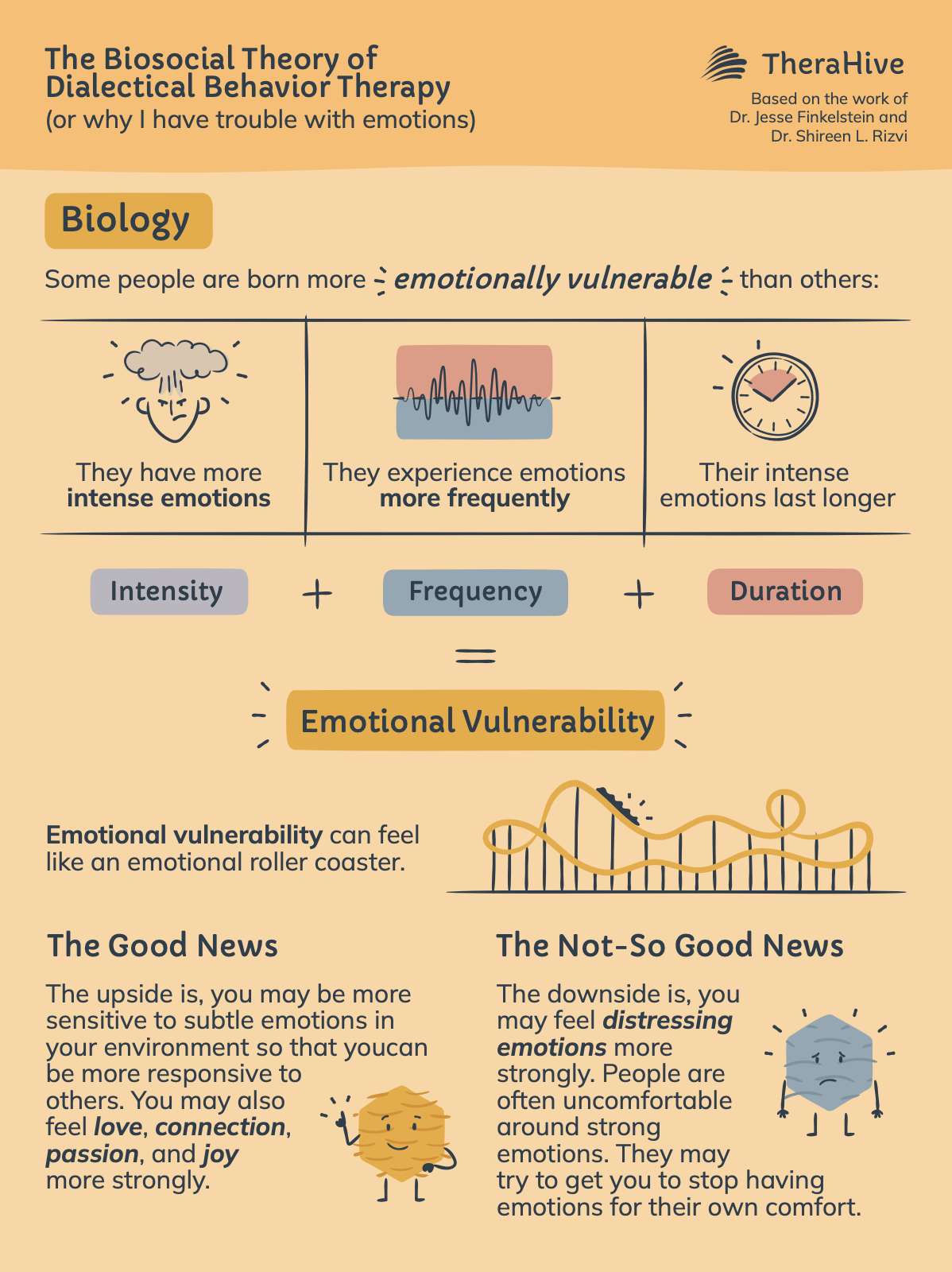
DBT's biosocial theory offers one way in. It frames emotional sensitivity as the product of biology and environment interacting over time, rather than a personal failing or a sign of bad parenting. That reframe matters because self-blame tends to keep a parent stuck in the same defensive loop, while something closer to self-compassion tends to free up the room needed to actually change a pattern.
From there, repair usually leans hardest on interpersonal effectiveness, and specifically on validation. A child who feels genuinely understood, even when a limit still stands, is far less likely to escalate than one who feels dismissed, which is part of why the GIVE skill covered above, staying gentle, genuinely curious, and willing to validate a child's frustration without necessarily changing the decision, tends to do more for a strained relationship over time than either giving in or shutting a conversation down.
None of this is a quick fix. A relationship pattern that took months or years to settle into rarely shifts after a single hard conversation, and the more realistic goal is a slow accumulation of moments handled differently, repeated often enough that a child starts to expect something different from a parent than they used to.
For parents looking to work through this in a structured way, our Improving Your Relationship With Your Child With DBT Skills mini course walks through these same ideas, biosocial theory, validation, and skills from all four modules, applied specifically to the parent-child relationship, in a self-paced format of short videos and worksheets.
Research on DBT for Families
Direct research on DBT delivered to families, as opposed to DBT delivered to an individual with a family member occasionally involved, is still a developing body of evidence rather than an established one, and that gap is worth naming plainly rather than glossing over.
What the research does show is encouraging for the pieces this page has covered. In the parent and carer skills group study referenced above, forty-one parents and carers of adolescents with severe emotion dysregulation and self-harm risk completed a six-month program, and their reported anxiety scores dropped from a mild-range average of 10.71 to 8.49, with depressive symptoms falling from 7.44 to 5.39, alongside the communication gains already described. Because that evaluation lacked a control group, it can't prove DBT alone caused every change; some of it may reflect the adolescent's concurrent treatment or simply the passage of time. A separate feasibility study of a twenty-session, parent-only DBT skills group delivered within a public mental health system found similarly significant reductions in parental helplessness and family power struggles, with adolescent clinical severity, rated independently by blinded assessors, improving in parallel months later.
The strongest comparative evidence for family involvement specifically comes from a pilot randomized trial testing parallel parent and adolescent DBT skills training against adolescent-only training, which found that adding a concurrent parent group produced measurably larger reductions in adolescent anxiety and depression along with a jump in reported positive family interactions, from a median of two times weekly at the start of treatment to eleven times weekly by its end. On the broader question of DBT's mechanism, the NIMH-supported trial of adolescents with prior suicide attempts found that DBT outperformed supportive therapy on emotion regulation specifically, and that parents in the DBT arm kept using more of the skills themselves well after treatment ended, a detail that points toward parents functioning as an ongoing source of skills reinforcement rather than passive bystanders. Earlier mechanism research in DBT skills groups more broadly, tested with adults managing bipolar disorder rather than families directly, found that gains in mindfulness tracked with lower emotional reactivity and better overall wellbeing, offering indirect support for why the same skill, taught to a whole household, might dampen the reactive cycles families describe.
Not every trial has landed in DBT's favor. The large UK systemic family therapy trial referenced earlier found no advantage over standard care in reducing repeat self-harm, a reminder that family involvement in treatment doesn't automatically translate to better outcomes regardless of the specific model or skills being taught. Taken together, the evidence base supports DBT's family-inclusive formats as a promising, still-maturing addition to adolescent DBT rather than a fully proven standalone treatment for family distress, with larger controlled trials needed to confirm which families benefit most and why.
Taking the First Step
Families rarely get to choose the moment they start looking for help. Usually it arrives already in progress, mid-crisis, with everyone exhausted and unsure whose job it is to hold things together. What the research and the skills covered on this page point toward is that recovery in a family setting tends to go further when more than one person in the household has the same concrete tools, not just the person whose crisis brought everyone to this point in the first place.
If the mindfulness, distress tolerance, emotion regulation, and interpersonal effectiveness skills covered here sound relevant to your own household, our online DBT Skills Groups teach this same four-module structure to adults, adolescents, and parents through separate, age-appropriate groups that a family can draw on together or individually.
For a parent or carer specifically looking to build these skills alongside whatever support their child is already receiving, our Parent DBT Skills Groups walk through this material with other parents navigating similar territory.
If you're ready to take the next step toward working with a therapist directly, our Ultimate Guide to Picking a DBT Therapist for Your Child walks through exactly what to look for and which questions to ask before committing to someone.
Frequently Asked Questions
Does the whole family need to participate for DBT skills to help?
No. While comprehensive DBT-A programs are built to include parents directly, research on parallel and parent-only skills groups suggests that even one family member learning and practicing these skills can shift household dynamics, particularly around validation and de-escalation. A family doesn't need full buy-in from everyone to start seeing change.
How is DBT for families different from family therapy?
Family therapy typically works on the relationships and communication patterns within a household directly, often with the whole family in the room together. DBT skills groups for families teach concrete, individually practiced tools, mindfulness, distress tolerance, emotion regulation, and interpersonal effectiveness, that each family member can use on their own, whether or not the rest of the household is doing the same work. The two approaches aren't mutually exclusive, and some families benefit from combining them.
Is DBT for families only for parents of adolescents in crisis?
Most of the direct research on family-inclusive DBT comes from adolescent programs, since that's where parent involvement was built into the model from the start. That said, the same four skill modules apply to any family navigating a member's emotion dysregulation, self-harm risk, or repeated relational conflict, regardless of the person's age.
What's the first sign DBT skills training might help a family?
If conversations in the household escalate faster than anyone intends, or if the same conflict keeps repeating without resolution, that pattern often points to a gap in shared skills rather than a lack of care. Distress tolerance and interpersonal effectiveness skills specifically tend to be where families start.
What happens in a DBT skills group for parents?
A typical session opens with a short mindfulness exercise, checks in on how the past week's skill practice went at home, teaches one new skill from that week's module with concrete family-specific examples, and closes with a practice assignment for the coming week. Sessions are psychoeducational and group-based, not individual psychotherapy or family therapy, and move through all four modules over the course of the program.
References
Cottrell, D. J., Wright-Hughes, A., Collinson, M., et al. (2018). Effectiveness of systemic family therapy versus treatment as usual for young people after self-harm: a pragmatic, phase 3, multicentre, randomised controlled trial. Lancet Psychiatry
Dorman-Ilan, S., et al. (2026). Feasibility of a parent-only DBT skills group in public mental health services: a pilot implementation study. Frontiers in Psychiatry
Eisner, L., Eddie, D., Harley, R., Jacobo, M., Nierenberg, A. A., & Deckersbach, T. (2017). Dialectical behavior therapy group skills training for bipolar disorder. Behavior Therapy
Huey, S. J., Henggeler, S. W., Rowland, M. D., Halliday-Boykins, C. A., Cunningham, P. B., Pickrel, S. G., & Edwards, J. (2004). Multisystemic therapy effects on attempted suicide by youths presenting psychiatric emergencies. Journal of the American Academy of Child & Adolescent Psychiatry
Mehlum, L., Tørmoen, A. J., Ramberg, M., Haga, E., Diep, L. M., Laberg, S., Larsson, B. S., Stanley, B. H., Miller, A. L., Sund, A. M., & Grøholt, B. (2014). Dialectical behavior therapy for adolescents with repeated suicidal and self-harming behavior: a randomized trial. Journal of the American Academy of Child & Adolescent Psychiatry
National Institute of Mental Health. Borderline Personality Disorder.
National Institute of Mental Health. (2021). Improved Emotion Regulation in Dialectical Behavior Therapy Reduces Suicide Risk in Youth.
Schulte-Frankenfeld, P. M., et al. Effectiveness of Attachment-Based Family Therapy for Suicidal Adolescents and Young Adults: A Systematic Review and Meta-Analysis. Family Process
Smith, L., Hunt, K., Parker, S., Camp, J., Stewart, C., & Morris, A. (2023). Parent and Carer Skills Groups in Dialectical Behaviour Therapy for High-Risk Adolescents with Severe Emotion Dysregulation: A Mixed-Methods Evaluation of Participants' Outcomes and Experiences. International Journal of Environmental Research and Public Health
Ye, S., Wei, X., Deng, C., Chen, P., Yang, C., Zhou, Y., & Dong, J. (2026). Effect of parallel adolescent and parent dialectical behavior therapy skills training vs. adolescent-only skills training on nonsuicidal self-injury: a pilot randomized trial.B BMC Psychiatry
Related Reading





.avif)