DBT for Parents

Parenting can bring out emotions that are hard to manage, even when you know exactly how you want to respond. A stressful morning or one more request at the end of a long day can push patience past its limit. Dialectical Behavior Therapy (DBT) offers practical skills for navigating those moments with more awareness and intention. Read on to learn how DBT can be applied to the challenges of parenting, from managing intense emotions to communicating more effectively even when things get difficult.

Jump to the topics:
Overview of DBT for Parents
Parenting doesn't require a diagnosis to become genuinely dysregulating. The sleep loss, the low-grade vigilance that never fully switches off, and the sheer volume of small decisions packed into an average day with a child can push even a formerly even-keeled adult well past what feels manageable. Researchers have started measuring this directly. A study validating the Parental Burnout Inventory found that parental exhaustion behaves as its own distinct syndrome, made up of physical and emotional depletion, a felt contrast with the parent someone used to be, and a growing emotional distance from their own children, and that it correlates with, but isn't reducible to, professional burnout, everyday parenting stress, or depression. It's a real and measurable pattern, not a character flaw or a sign someone shouldn't have become a parent.
Dialectical Behavior Therapy (DBT), developed by psychologist Marsha Linehan in the 1990s to treat chronic suicidality and borderline personality disorder, wasn't built with parenting in mind at all. But its four skill modules, taught and rehearsed directly rather than mainly discussed, speak to exactly what tends to give out first when a parent is running on empty: the ability to notice an emotional spike before it turns into a slammed door or a voice that's louder than intended. Emotion dysregulation doesn't just make parenting harder from the inside. It also shapes what a child absorbs, since children learn a great deal about handling their own feelings by watching how the adults around them handle theirs. That's the thread each of the following four modules works from a different angle:
- Mindfulness slows down the gap between a trigger and a reaction. A parent can go from calm to shouting in under two seconds when a child ignores a request for the fourth time. Mindfulness skills build in a pause, however brief, where a choice becomes possible again.
- Distress tolerance covers the minutes reasoning can't reach. A meltdown in the cereal aisle or a 2am wake-up rarely leaves room for a calm internal conversation. This module supplies fast, physical tools for getting through the worst of it without making the situation worse.
- Emotion regulation works on what builds up before the next blowup. Guilt, resentment, and a running sense of failure tend to accumulate quietly between hard moments, and this module addresses that buildup directly rather than waiting for it to erupt again.
- Interpersonal effectiveness makes it possible to ask for help and hold a limit without drowning in guilt. Parenting rarely happens in isolation, and this module gives people concrete language for the conversations, with a co-parent, a child, or extended family, that tend to get avoided the longest.
Parenting stress rarely shows up as a single, isolated problem, which is part of why these four modules work best together rather than one at a time. A parent might use a mindfulness skill to catch the first flash of irritation, then reach for an emotion regulation skill to work through the guilt that follows an hour later, pairing skills across modules rather than treating each one as a separate toolkit reached for on its own. Learn more about skill stacking in the case study video below.
DBT vs. Other Treatments for Parents
Parenting support doesn't have one standard treatment protocol, and a few different approaches tend to come up in the same conversation. Behavioral parent training programs, mindfulness-based parenting programs, and individual therapy for the parent's own mental health each offer something real, and DBT isn't positioned to replace any of them so much as to fill a gap the others tend to leave open: skills for the exact moment a parent's own emotions are running too hot to parent the way they intend to.
Behavioral parent training, the family of programs built around consistent praise, clear consequences, and structured routines, has the deepest evidence base of any parenting intervention and remains a strong starting point for many families. Its limitation shows up specifically with parents who are themselves dysregulated. A paper on applying DBT to parent skills training makes the case that poor outcomes in standard parent training are linked to parental affect dysregulation in particular, since a parent can learn a behavioral technique perfectly well in a calm therapy room and still lose access to it the moment their own emotions spike at home. That's the exact gap DBT's skills, especially distress tolerance and emotion regulation, are built to close, less by replacing behavioral parenting techniques and more by giving a dysregulated parent something to reach for in the moment those techniques are hardest to remember.
Mindfulness-based parenting programs sit closer to DBT, since both draw on similar present-moment awareness practices. A randomized controlled trial comparing mindful parenting training to standard behavioral parent training found that both approaches improved parenting practices and reduced child behavior problems, but that mindful parenting produced more sustained gains specifically in parents' own emotional competence, while behavioral training built broader knowledge of parenting techniques. That split maps closely onto DBT's own structure: its mindfulness module targets the same present-moment awareness, while distress tolerance, emotion regulation, and interpersonal effectiveness extend that awareness into concrete action for crisis moments, difficult conversations, and the guilt that tends to follow both.
Individual therapy for a parent's own anxiety, depression, or trauma history addresses real and often underlying territory that a skills group alone won't reach, particularly when a parent's reactivity is rooted in their own upbringing or an unresolved diagnosis. What individual therapy doesn't always supply is something concrete to do with your hands and your voice at 6pm when dinner is burning, a child is screaming, and the old pattern is already halfway out. DBT's skills modules are built almost entirely for that kind of moment, less as a substitute for deeper individual work and more as something to run on while that work is in progress.
A newer category of research combines DBT skills directly with parent training curricula in a single program, and it's worth naming as its own category since it's the closest cousin to what a DBT-only skills group offers. Programs integrating DBT skills training with parenting-specific content have shown real promise in early trials, though this remains an emerging area rather than an established standard of care, with more detail in the research section below. None of this makes DBT the single correct choice over other approaches. It makes it a strong option for a parent whose own emotional reactivity, not a lack of parenting knowledge, is what's getting in the way.


Psychoeducation as a Starting Point for Parents
Most parents don't arrive at the idea that they need support with their own emotions through a clinician's referral. They arrive at it after a moment they're not proud of, a child repeating a harsh word back, or a quiet realization that they sound exactly like a parent they swore they'd never sound like. That's part of what makes psychoeducation especially useful here. A structured, skills-based introduction to what's actually happening in the body during a parenting flashpoint gives someone a way to understand a pattern that otherwise just feels like a personal failing, and then gives them something concrete to practice, rather than leaving them with self-criticism and no next step.
Understanding a pattern and changing it are two different things, though, and the difference matters more than it might seem. A case study examining how mothers with severe emotion dysregulation used DBT skills in a group setting found that nearly half of the skills these mothers reported using in a given week were applied directly in parenting situations, even though the group itself wasn't designed as a parenting program. That's a meaningful finding. It suggests that once a parent has learned a DBT skill for their own emotion regulation, they tend to reach for it in exactly the moments that matter most, without needing every skill to be relabeled or repackaged specifically for parenting first.
Fitting a weekly commitment into a life already stretched thin by childcare, work, and everyone else's schedule is its own real barrier, which is part of why the format a skills group is delivered in matters as much as the content. Meeting from home removes the added logistics of arranging a babysitter just to attend a session about becoming a steadier parent, and virtual learning has become a genuinely practical way for a stretched parent to fit dialectical behavior therapy groups into a week that already has no obvious openings.
This is the model TheraHive builds on: a live, group-based space where DBT's four modules get taught and rehearsed directly, not left as concepts to read about alone. The sessions are psychoeducational, not psychotherapy and not a treatment for any diagnosis. The goal is teaching and practicing skills, alongside whatever individual therapy a parent may already be doing, not replacing it. For a parent whose guilt often keeps them from prioritizing their own support in the first place, a lower-friction way to start tends to matter quite a bit.
Mindfulness Skills for Parents
Parenting compresses an enormous amount of stimulation into very little time, a request ignored, a sibling fight breaking out, a work email buzzing in the background, all landing within the same sixty seconds. Mindfulness is the DBT module built to interrupt the reflex that follows, and it works through specific skills practiced directly rather than a vague instruction to stay calm.
Observe is usually the starting point. It means noticing an internal sensation as it happens, before deciding what to do about it, the heat rising in the chest, the clenched jaw, the urge to raise a voice a half-second before it actually rises. For a parent, this often means catching that first physical spike while a child is mid-tantrum in a grocery store checkout line, instead of already three words into shouting before realizing there was ever a choice point at all. The exercises built around this skill aren't about achieving a calm mind. They're about creating a small gap between an urge arriving and a person acting on it automatically.
Describe follows Observe and asks for something more precise. It means naming what was just noticed in plain, factual language instead of a sweeping judgment. "I'm noticing my jaw is tight and I want to snap" reads very differently than "I'm losing it," even though the two often collapse into one without practice. That distinction, worked at quietly and repeatedly, is often the first real leverage a parent gets over a reaction that used to feel involuntary.
One-mindfully addresses a related pattern common to parenting specifically: doing one thing while three other things run in the background. A parent can be technically present at a child's bedtime story while mentally drafting tomorrow's grocery list, replaying an argument, or bracing for the next interruption. Practicing this skill means deliberately bringing attention back to the story, the child's face, the actual moment, each time it drifts. It won't stop the pull toward multitasking from showing up. It gives a parent somewhere specific to keep returning their attention to instead.
Nonjudgmentally tends to matter most for how a parent treats themselves in the aftermath of a hard moment. A pattern built around reactive parenting usually comes loaded with self-criticism the moment it's interrupted, something like "a good parent wouldn't have snapped like that." Practicing nonjudgmentally means describing what happened, "I raised my voice, and I noticed it and stopped," without immediately layering a verdict on top of it. That layering is exactly what makes the next flashpoint more likely, since shame tends to shorten a person's fuse rather than lengthen it.
Underneath all four of these sits Wise Mind, the place these DBT mindfulness exercises are ultimately building toward, where emotion and reason inform each other instead of one overriding the other. A parent who can observe a spike, describe it accurately, and hold it without judgment has created enough space to consult that steadier place before the next word comes out.
Try one of our brief and calming mindfulness exercises below. For the full playlist of free mindfulness exercises, visit our YouTube channel.


Distress Tolerance Skills for Parents
Some parenting situations can't be solved in the moment. A child may still be screaming, the argument may still be escalating, and the parent may still be angry, overwhelmed, or running on almost no sleep. Distress tolerance isn't about making those feelings disappear or finding the perfect response under pressure. It's about staying in the situation without letting intense emotions take over, creating enough space to get through what is happening now and deal with the rest later.
The distress tolerance techniques taught in a DBT skills group stay intentionally simple, because complexity is exactly what an overloaded, urgent-feeling moment can't process. Splashing cold water on the face, stepping outside for thirty seconds of hard exhale, or holding an ice pack against the wrists, paired with a short burst of movement and slow counted breathing, works on the body directly instead of asking the mind to reason its way out of anything. This combination is often taught as the TIP skill, and it exists because a nervous system flooded mid-crisis isn't especially reasonable to begin with. A parent whose patience tends to run out hardest right before bedtime, after a full day of managing everyone else's needs, might use exactly this kind of physical reset before walking back into the room.
The STOP skill covers a slightly different moment, the one where a parent catches themselves reaching automatically for a raised voice or a harsh punishment and deliberately pauses before going any further. Stopping, stepping back, and observing what's actually happening instead of what feels urgent gives a parent the few seconds they usually skip past entirely, and a response can be chosen rather than defaulted to.
Radical acceptance sits underneath both of these, and it's often misread as giving up or letting a child off the hook. It's closer to the opposite. It means acknowledging, without flinching, that this particular moment is genuinely hard, that a four-year-old having an enormous feeling in a public place is simply what's happening right now, so that the energy that would otherwise go into fighting that fact can go toward actually getting through it. A parent doesn't need to also be at war with the unfairness of the situation while managing it. That second fight, insisting the meltdown shouldn't be happening at all, is often what turns a hard ten minutes into a day both people remember badly.
For a deep dive on STOP and other distress tolerance skills, check out the Thriving With DBT podcast episode below where TheraHive co-founder Dr. Alicia Smart walks through the skills in real-time with a real TheraHive student.
Emotion Regulation Skills for Parents
It's easy for one difficult moment to color how a parent sees the entire day. Losing patience at bedtime can make everything that came before it feel insignificant, even when most of the day went fine. DBT's approach to emotion regulation starts with slowing down that kind of judgment and looking more closely at what is actually happening beneath the reaction. The goal isn't to never get overwhelmed. It's to understand those reactions well enough that they don't automatically dictate what happens next.
Checking the facts is one of the more direct tools here. A thought like "I just ruined my child for life by yelling once" feels, in the moment, like plain truth. DBT treats it as a claim that can be tested. Has one hard moment actually caused lasting harm before, or is this a catastrophic prediction that's never been checked against what's actually known about kids and repair? When the claim doesn't hold up, the work becomes changing the emotion it produced rather than continuing to spiral on it.
Opposite action works from the other direction, meaning a parent acts deliberately against an urge the facts don't support. If shame says "isolate yourself and avoid your child for the rest of the evening because you don't deserve to be around them right now," opposite action might mean getting back down on the floor within the next twenty minutes and re-engaging, even while still uncomfortable. That's not pretending nothing happened. The urge to withdraw is often driven by shame itself rather than by anything the relationship actually needs, and practicing this skill repeatedly is what shifts a pattern that's been running on autopilot.
Alongside the thinking side of the module sits something more physical: reducing the everyday depletion that lowers a parent's threshold for the next flashpoint in the first place. Skipped meals and interrupted sleep do this on their own, without any single trigger required. A short-tempered evening often has less to do with what a child actually did and more to do with a parent who hasn't eaten since 7am, which makes protecting even one of these basics matter more than it might seem to on paper.
Accumulating positives works on a longer timescale. It means deliberately noticing and registering things that went well independent of how the hardest moment of the day went, a genuine laugh at dinner, five quiet minutes with a book, a goodnight that landed warm instead of rushed. For a parent used to measuring an entire day by its worst ten minutes, this is often the first practice that puts anything else on the ledger at all.
Understanding what drives your reactions is easier when you have a sense of how much stress you're carrying to begin with. If parenting has been feeling more overwhelming lately, the Parenting Stress Scale (PSS) can help you step back and put that experience into perspective. Take the assessment below to get a clearer picture of your current parenting stress level.


Interpersonal Effectiveness Skills for Parents
Interpersonal effectiveness is where parenting stress shows up most visibly, because so much of it plays out in relationships, with a co-parent, a child, or extended family offering unsolicited advice at exactly the wrong moment. The skills in this module aren't about becoming a stricter or more distant parent. They're about giving a parent a way to ask for what they actually need and hold a limit without the relationship falling apart in the process.
Sometimes the task is asking for something directly, more help with the bedtime routine, a night off, or a partner who actually notices when the other person is running on fumes. DEAR MAN handles this by walking through describing the situation factually, expressing feelings without hinting at them, and then asserting the actual request instead of hoping a partner will simply notice on their own. For a lot of parents, the Mindful step matters most here, since it means staying focused on the actual ask ("I need you to handle bath time tonight") even when the conversation starts drifting toward old arguments about division of labor.
Other times the harder move is holding a limit with a child or a relative without turning it into a lecture or an apology tour. A grandparent who criticizes a parenting choice in front of the kids, or a child who's learned that enough pushing eventually wins, both call for the same underlying skill. FAST is built for exactly this: being fair to everyone in the exchange, skipping unnecessary apologies for a reasonable limit, sticking to one's own values instead of caving to keep the peace, and staying truthful rather than softening a limit into something easier to deliver in the moment. Stating it once, clearly, without extra justification stacked on top, is the harder part, and it's what FAST actually trains for.
GIVE handles a different problem: staying warm with a child even in the middle of setting a limit or working through a hard conversation. Being gentle in tone, genuinely curious about what a child is feeling even while holding a line, and validating that their frustration makes sense, without necessarily changing the decision, does more for a relationship over time than either giving in or shutting the conversation down.
Improving Your Relationship With Your Child
The skills covered so far are aimed mostly at a parent's own regulation, but for some families it's the relationship itself, not just the reactive moment, that feels stuck: a pattern of conflict that repeats no matter how hard both people try, or a child who pulls away the second things get tense. Repairing that kind of pattern usually starts in an unexpected place: not with better techniques, but with a shift in how a parent understands their own reactivity in the first place.
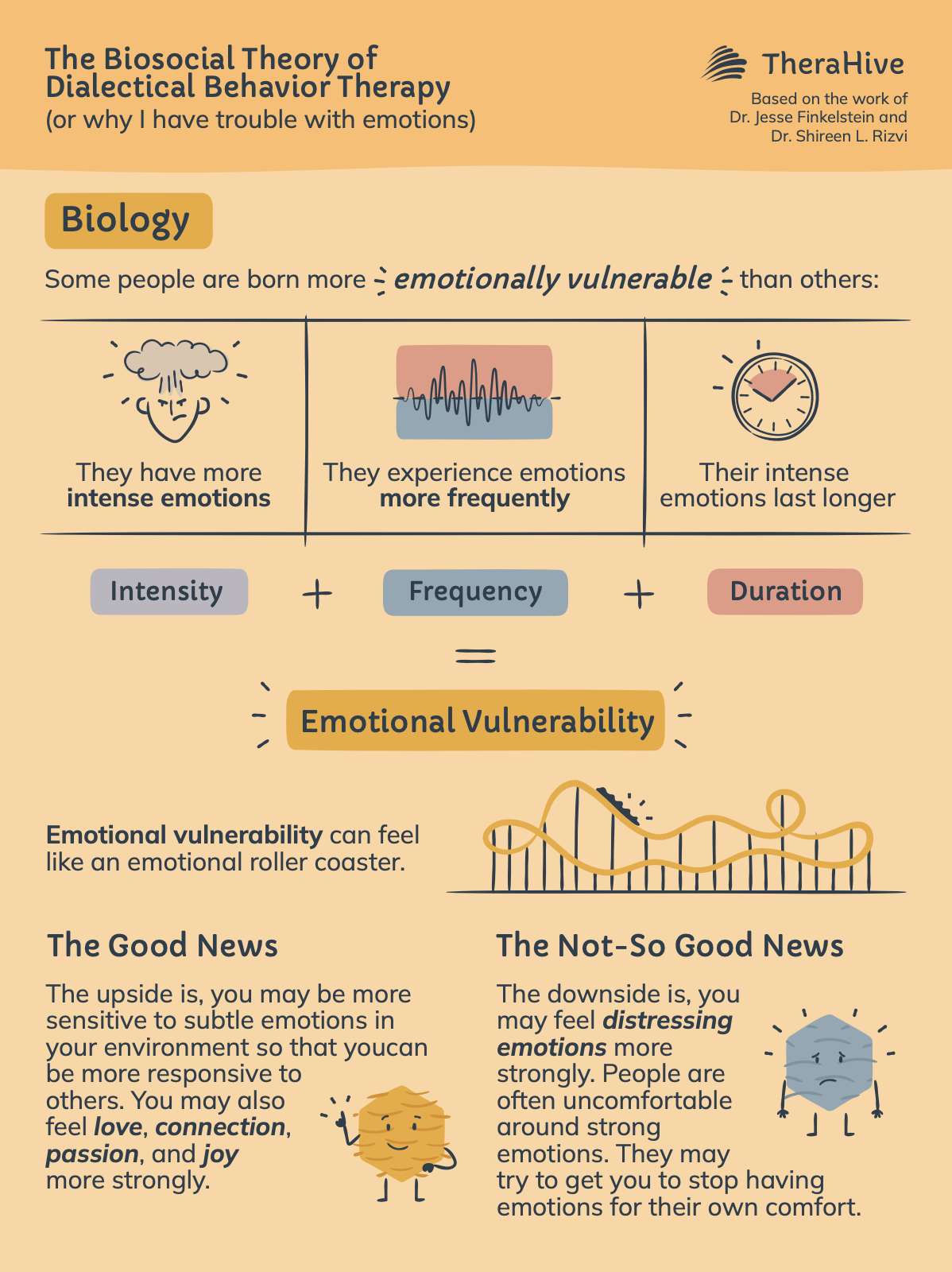
DBT's biosocial theory offers one way in. It frames emotional sensitivity as the product of biology and environment interacting over time, rather than a personal failing or a sign of bad parenting. That reframe matters because self-blame tends to keep a parent stuck in the same defensive loop, while something closer to self-compassion tends to free up the room needed to actually change a pattern.
From there, repair usually leans hardest on interpersonal effectiveness, and specifically on validation. A child who feels genuinely understood, even when a limit still stands, is far less likely to escalate than one who feels dismissed, which is part of why the GIVE skill covered above, staying gentle, genuinely curious, and willing to validate a child's frustration without necessarily changing the decision, tends to do more for a strained relationship over time than either giving in or shutting a conversation down.
None of this is a quick fix. A relationship pattern that took months or years to settle into rarely shifts after a single hard conversation, and the more realistic goal is a slow accumulation of moments handled differently, repeated often enough that a child starts to expect something different from a parent than they used to.
For parents looking to work through this in a structured way, our Improving Your Relationship With Your Child With DBT Skills mini course walks through these same ideas, biosocial theory, validation, and skills from all four modules, applied specifically to the parent-child relationship, in a self-paced format of short videos and worksheets.
Research on DBT for Parents
Direct trials on DBT built specifically for parents are still an emerging area, and it's worth saying plainly that the evidence base here is smaller and earlier-stage than DBT's research base for conditions like borderline personality disorder. Most of what exists so far comes from pilot studies and case studies rather than large randomized trials, and the honest read of the research is that it's promising, not yet definitive.
What that early evidence does show consistently is that a parent's own DBT skill use carries over into parenting moments without much extra effort. The case study on mothers with severe emotion dysregulation referenced above found that these mothers applied close to half of their weekly DBT skills directly to parenting situations, even in a group that wasn't designed around parenting content specifically.
More targeted programs have started testing what happens when DBT skills are paired directly with parenting content. An idiographic case study integrating DBT skills with parent training for parents of emotionally dysregulated preschoolers tracked weekly outcomes across 24 sessions and found large reductions in parental emotion dysregulation alongside increases in supportive parenting for most participating parents, along with high attendance and satisfaction, though the sample size was small and the design didn't include a control group. A related pilot trial testing a combined DBT skills and parent training program for parents in recovery from substance use found large reductions in emotion dysregulation and parenting stress among parents who completed a 20-week telehealth version of the program, evidence that a structured skills format can hold up even for parents facing significant additional stressors.
A separate feasibility pilot testing the BRIDGE program, which pairs DBT skills with parenting content specifically for depressed mothers of preschoolers, found high retention alongside large reductions in maternal depression and improvements in child mental health outcomes over 20 weeks. Programs like this remain in early testing, but the direction of the results lines up with what mechanism-focused research on DBT has shown for years: skills that improve a person's own emotion regulation tend to ripple outward into their closest relationships, parenting included.
Attending a DBT skills group consistently, rather than encountering the concepts once, is what this research points to as the actual driver of change, which matters for a population that often has the least flexible schedule of anyone seeking support. Early evidence on virtual DBT skills training suggests skill acquisition holds up reasonably well online, and for a parent juggling childcare, work, and a partner's schedule, a virtual DBT skills training format that doesn't require arranging coverage just to attend a session tends to translate into showing up more consistently, which the research base points to as the thing that actually matters most.
Taking the First Step
There's no single right place to start. What matters is coming back to the skills often enough that catching a spike before it turns into a blowup starts to feel like something a parent can count on, not a lucky break. Where to go from here depends on what would actually be useful right now.
For parents ready to build that kind of repetition with real support behind it, our Parent DBT Skills Groups walk through mindfulness, distress tolerance, emotion regulation, and interpersonal effectiveness with a trained facilitator and a small group of other parents working through similar pressures, the kind of structured practice that turns a skill from something you read about into something you can reach for without thinking.
If a multi-week commitment feels like a lot to take on right now, on top of everything else parenting already asks of you, our free Navigating DBT Mini Course covers the same four modules in a shorter, no-cost format with no obligation to go further. It's a low-stakes way to find out whether DBT is a fit before deciding on anything bigger.
For a parent reading this page and realizing that what's needed most right now isn't more skills for themselves but support for their child, our Guide to Picking a DBT Therapist for Your Child walks through what to look for and which questions to ask before choosing someone.
However far you take it from here, starting small still counts as starting.
Frequently Asked Questions
Does struggling to stay calm with my kids mean something is wrong with me as a parent?
No. Parental burnout and reactive parenting are well-documented, measurable patterns tied to depletion and emotion dysregulation, not evidence of a character flaw or a sign that someone shouldn't have become a parent. The pattern is real and workable with structured skills.
Can DBT help even if my child's behavior itself doesn't change?
Yes. DBT's skills are built around what a parent can do with their own reactions, regardless of what a child does. Distress tolerance and emotion regulation skills in particular are designed to help a parent hold steadier ground even during a difficult developmental phase that isn't going to resolve on its own timeline.
How is DBT for parents different from a standard parenting class or behavioral parent training?
Standard parent training programs focus on techniques like consistent praise and consequences, which have strong evidence behind them but assume a parent can access and apply the technique in the moment. DBT skills groups add tools specifically for when a parent's own emotions are running too high to use those techniques, working alongside a parenting class rather than replacing one.
How do online DBT skills groups work for parents?
An online DBT skills group typically meets weekly with a small group of participants and a trained facilitator, moving through the same four modules covered on this page. Sessions are psychoeducational rather than individual psychotherapy, meaning the focus stays on learning and rehearsing skills in a structured group format, meant to complement any individual therapy a parent may already be receiving.
What's the first sign DBT might be a good fit for parenting specifically?
If the gap between an irritating moment and a reaction feels close to nonexistent, snapping before there's any sense a choice was even available, that's often a sign that distress tolerance and mindfulness skills specifically, rather than more parenting knowledge alone, are what's needed to create room for a different response.
What happens in a DBT skills group session?
A typical session opens with a short mindfulness exercise, checks in on how the past week's skill practice went, teaches one new skill from that week's module with concrete examples, and closes with a specific practice assignment for the coming week. Sessions are structured and group-based rather than open-ended discussion, and participants move through all four modules, mindfulness, distress tolerance, emotion regulation, and interpersonal effectiveness, over the course of the program.
References
Ben-Porath, D. D. (2010). Dialectical Behavior Therapy Applied to Parent Skills Training: Adjunctive Treatment for Parents With Difficulties in Affect Regulation. Cognitive and Behavioral Practice
Everett, Y., Lightcap, A., O’Brien, J. R., Weinstein, N. Y., & Zalewski, M. (2025). Integrating Dialectical Behavior Therapy Skills and Parent Training for Dually Dysregulated Parents and Children: An Idiographic Case Study. Cognitive and Behavioral Practice
Kwan, D. H., Lam, S. F., & Shum, K. K. M. (2026). Randomized controlled trial evaluating the effectiveness of mindful parenting and parent management training. Behaviour Research and Therapy
Martin, C. G., Roos, L. E., Zalewski, M., & Cummins, N. (2017). A Dialectical Behavior Therapy Skills Group Case Study on Mothers With Severe Emotion Dysregulation. Cognitive and Behavioral Practice
Mikolajczak, M., Gross, J. J., Stinglhamber, F., Lindahl Norberg, A., & Roskam, I. (2020). Is Parental Burnout Distinct From Job Burnout and Depressive Symptoms? Clinical Psychological Science
Roos, L. E., Kaminski, L., Stienwandt, S., Hunter, S., Giuliano, R., Mota, N., Katz, L. Y., & Zalewski, M. (2021). The Building Regulation in Dual-Generations Program (BRIDGE): A Mixed-Methods Feasibility Pilot of a Parenting Program for Depressed Mothers of Preschoolers, Matched with Dialectical Behavior Therapy Skills. Child Psychiatry and Human Development
Everett, Y., Frigoletto, O. A., Shryock, I., Hernandez, A. C., Lee, A. H., Cuellar, R., Mudiam, K., Metcalfe, R. E., Mottweiler, C., & Zalewski, M. (2026). DBT Skills + Parent Training for Preschool Parents With Emotion Dysregulation and Substance Misuse. Borderline Personality Disorder and Emotion Dysregulation
Related Reading





.avif)